Saturday, October 31, 2015

thlogé

This week’s main objective was to understand a little more about WP2. However, this week was the first week where I was not happy with something in class and it was Uncle Zach making a prediction that could be very misleading. He claimed, “The Eagles will beat the Cowboys this Sunday”. This statement however is (1) not true (2) was a great example to use in helping us understand how many sources we need and where are sources could come from. Other then that, we worked on PB2B and in that assignment I learned just how specific these moves can be in an essay as I chose to analyze a document on Teenage Dating. A couple moves that I noted from the article were bulletin points, titles, and other moves that affected the credibility of the essay. Altogether, these moves were important in establishing a personality to the author and allowed for a more effective read by the reader.
            This last Wednesday I believed we had a very informational day in class even though we took a little break from big concepts and focused on brackets, “says”, and writing an essay. The concept I was probably most interested in was the commenting on an essay procedure, which helps “keep you sane”. I thought that would be helpful for me not only keep me sane from writing classes (jk btw) but by organizing my ideas more effectively.  It was also helpful to review words that could replace “say” as you become a more scholarly writer and also learn that Wikipedia is helpful in finding context in a subject!

            All in all, this week was a good writing week in Phelps 1525.

Wednesday, October 28, 2015

Moveeeee out for PB2B!

Moves, which might be a surprise, do not only exist in sports but in academic settings as well. Whether on the writing or reading end of a piece of literature, moves can help develop writing skills that best fit one’s style of writing or be analyzed to figure out how these moves were effective in producing an effective piece. In essence, the importance of moves lies on the ability to analyze them and make them your own. In They Say, I Say by Gerald Graff, Cathy Birkenstein, and Russel Durst these authors have been able to show some common moves that follow similar structures and how they each have a unique purpose that ranges from simply becoming more credible to creating an informal tone because they want the reader to feel more comfortable reading the article. The moves are not limited to simply academic articles but are found in a wide range of pieces including the article “When To Let Your Teenager Start Dating”.
In Navigating Genres by Kerry Dirk there is an enormous amount of moves similar to those of They Say, I Say including these:
1.     “As a result, I decided to make this essay a mix of personal anecdotes, examples, and voices from teachers of writing” (Voice Marker)
2.     In other words, knowing what a genre is used for can help people to accomplish goals, whether that goal be getting a job” (Explaining quotes)
3.     “You are already probably familiar…” (Standard Views)
4.     Devitt argues that ‘people do not label a particular story as a joke solely because of formal features but rather because of their perception of the rhetorical action that is occurring’” (X argues)
5.     “I will admit that the word genre...” (Voice Markers)

            To prove that moves could be found in almost any piece of literature and not just in academic pieces like Navigating Genres, the article “When To Let Your Teenager Start Dating” is dissected for some of its more effective moves. This informational article is meant to provide help for parents who are looking for advice in the field of teenage dating which could be some of the hardest times for a parent. In return, the author uses his moves to make his article the most clear and effective.
One move that I like to call “section 5” is used by the author to get into specific types of dating and so the article has five different sections all responsible for different levels of dating. The use of this is important to note because it makes it clearer for the reader (typically a parent) to read this and understand that there exists different intensities of dating and each should be treated properly. For example, section one is on “group dating” that seems to exist and is recommended for 14 year olds. At a more intense stage of dating, “solo dating” exists too but is recommended by professionals to not start until the age of 16. Altogether this shows how the use of different sections allows for the different recommendations according to the intensity of the dating.
Another move, which I like to call “Calling you out”, exists under the category of “First Heartbreak” which the author in a bold phrase specifically gives directions on how to treat a teenager post- breakup followed by an example of what one can say. The use of this allows the article to be easier to dissect and read so if a parent wants to come back for advice from this essay, the directions will be clear and bold for them to find and treat their child properly with the help of examples. Not only this but it serves as a hands-on section of the article that can appeal to parents because it makes it easier on them too simply follow directions.
The Stereotype- This move would probably be a child favorite. In this move the author acknowledges that most “adults generally take a cynical view of teenage romance… ‘It’s all about sex’” which allows him to connect to the parents by acknowledging some of the common misconceptions of teenage dating exists within the parent community and simply follows by stating that this cynical view can be seen as unhealthy for the relationship between parent and son or daughter. The author’s acknowledgement of common misconceptions and showing some cons to them make this more effective and discourages parents from doing it using almost a scare tactic. 
One of the more satirical moves used I call “The Fake Conclusion” and starts because the author has given the reader (the parents) directions on how to treat their child according to the different intensities of dating, the author chooses to include some of the positive reactions their child could have. For example, the author believes that a child could react to a story (which is recommended telling after a break up for any anyone who has children) by saying “Now I’m thankful that she broke up with me. Because if she (Dad’s ex girlfriend) hadn’t, you’d never have met mother!”. This possible reaction that the author chooses to include could be considered an “ideal reaction” and so parents should find excitement out of this and follow the article’s recommendations making it an effective move.
Last, “The Ultimate Seller” is used by the author to include information stated by a professional, a pediatrician, who recommends to allow the children to be involved in “group dating” because of its effective transition onto “solo dating”. However, the author was very specific in including and possibly even choosing the pediatrician by including that this pediatrician is “the father of two grown children”. This move allows for even more credibility to a professional in this field because he too has gone through the same situations with his children and so parents should feel less nervous about following the author’s recommendations.
            All in all, moves are found in all forms of literature and altogether these moves in a single piece of literature help the reader form their arsenal of moves and the writer help the purpose of the piece.


Monday, October 26, 2015

4 Thlog #

            This week we began learning moves, which will later help us write our WP2. At first I’ll admit having a difficult time answering why these moves were important (maybe because I was hoping we were going to learn about basketball or football moves) but then I did realize that the moves of basketball players might not be THAT much more different than a writer. Essentially, both the basketball player and writer have similar goals in being effective at their respective discipline and so they need to use moves that will help them accomplish this. So as weird as it sounds to say of a writer… a writer too has moves and can be as simple as their word choice and syntax or as complicated as trying to set a certain tone from a paragraph that sets it apart from the others.
            A really cool activity that helped me understand just how easily one can find moves was watching The Rock’s signature move over and over again until the class got so detailed that we realized even the Rock pushing his opponents arm in before he absolutely destroys him (His opponent’s RIGHT arm) was an important move to note in the effectiveness of his overall signature move.
            Overall, this class has continued to help me become a better writer and have enjoyed this routine we have going inside the classroom with the free writes and class discussions.


P.S. I also learned how to use italics more effectively but I just decided to incorporate that in the first paragraph rather than to talk about it.

Wednesday, October 21, 2015

PB2A!

“The Impact of Virtual Configurations on Machine Learning” and “Drinking to our health: can beverage companies cut calories while maintaining profit?” when put side by side seem to be highly thought out and intellectual research papers; however, when reading them both it is clear that “The Impact of Virtual Configurations on Machine Learning” makes absolutely no sense and was clearly generated (by SciGen). It seems as if a paper computer generated would be easy to spot; however, it was clear that the SciGen website too has studied conventions allowing for a very nice looking but very fraud essay.
To begin seeing how both papers can look so similar but different in content one can simply look at the titles and notice that they both chose to be direct and informational in their title choice. To begin, the SciGen generator chose to be straightforward and state that they would speak of the “impact of virtual configurations on machine learning”. This makes it clear to the audience what exactly they are reading and even what they can get out of the paper. On the other hand, Kleiman’s choice of the title includes a question that tells what the paper is going to be about. This question in the title goes so far that it arguably could be defined as the thesis statement of the essay.
            As the paper continues the SciGen paper not only is full with content but also is well organized to subheadings that could be found in both papers. The very first subheading is titled “Abstract” which essentially holds the thesis statement. In this case being “Jewise, our new method for atomic epistemologies, is the solution to all of these challenges.” Although this is a computer-generated paper, a thesis statement exists passing the “arguability” test for thesis statements and we know the essay will revolve around this “new method” and its effectiveness. A little different approach from the SciGen paper, Kleiman’s article chose to use questions as the thesis of the article, which can also be found at the end of their first subheading, the “introduction”. The reason why the author chose to use multiple questions as the thesis statement is because instead of taking a side just yet on the argument the research questions allow for the author to develop the research and once presented then takes a side on the situation.
The use of different approaches to their thesis statements then affected the layout, which the author presented the ideas; in other words, the subheadings don’t exactly follow the same order. Kleiman’s essay because of the questions presented as his thesis choses to get right to “data and methods” which is split into different groups of data that help explain the context in which the data is being presented. So by choosing to study the years 2000 to 2010, they not only take into consideration the increase in revenue by the Coke and Pepsi companies but also choose to take into consideration noticeable trends and even the population changes within those years. On the other hand, the SciGen paper chooses to hold off on the data until a few subheadings down and instead shows the “architecture” of the experiment and later the “implementation” of the experiment, which could be seen as a more hands-on study than that of the beverage drinks. In sum, the reason for the difference in the thesis statement and the presentation of the research can be due to the difference in ways the author’s attained the research
The research paper for the beverage drinks could be seen as a research paper using online sources for their information on profit, energy use, and calories per drink to help shape their essay. On the other hand, the SciGen generator seems to be conducting an experiment in which they get in their information on. The use of experiments rather than factual evidence to back up their paper shows that SciGen could be given less of validity as a paper even though it is a computer generated paper. The research paper on beverages on the other hand could be seen as more factual. This also could be affected by the chosen topics of studies in which one could be experimented on in order to find information while for the beverage paper its much harder to experiment to find their information rather than looking it up online.
The similar at first glance conventions of both these papers show that the subheadings, graphs, thesis statements, and titles all are very common to find in research papers showing their success; however, there also exists differences in their conventions because each study is under a different genre of study like beverages, sciences, humanities, etc. The conventions that do exist under both papers are important to study because their repetition shows success.


Monday, October 19, 2015

Thlogger #3

This week our WP1 was due so throughout the week I dedicated my time on working on the final draft. First, i took Zack’s advice and took many breaks in between which was very relaxing and had a fresh mind after e. After reading some of my peer’s writing and revising the prompt questions I realized my first draft was awfully terrible. I wasn't following the prompt and so I rewrote pretty much the whole essay. In my second essay I decided to focus more on the thesis and having a better balance of quotations from our readings, source quotes, and analysis. Turned out knowing what exactly I am arguing (a clear thesis) and including a few more quotes from the reading really made my essay more effective. As great as it would sound to say that I learned to do this on my own the reverse outline was an amazing exercise and I will definitely continue to use it in the future. The reverse outline really allowed me to visually see what was the meat of my essay and what I lacked on. Another writing tip that has heavily helped me is that there is nothing wrong with being direct and getting to the point which is a lot different from the old ways of writing I was accustomed to where I would go on for sentences trying to get to my point.
Overall, I’m excited for the progress I have made and really enjoyed working on the WP1.

Sunday, October 11, 2015

Thlog Week II

This week we worked on PB1B which was actually a good time to work on (which kind of surprised me considering homework tends to not be one of my favorite things to do unless i get extra credit for saying it is. SO if that's so let me just say how much I LOVE homework). Well we were given three generators to find the conventions of each generator. For the most part it was a very manageable assignment; however, I do have to admit I had a bit of trouble coming up with the conventions of a meme. I mean how many conventions could there be for a picture with five words on it? It was not until we mentioned the conventions in class that I realized even the most minuscule conventions affect the total effectiveness of a piece. For example, the text on the meme is huge because the color, size, font, the background color that it's written over all effect the way in which we look at the meme. I guess what I'm saying is in oppose to my knowledge of conventions and genres last week I did not realize that such small conventions are important to acknowledge when analyzing a piece.

Together learning more about conventions and a few other grammatical rules we are supposed to have our WP1 done by class on Monday. Although the WP1 is not supposed to be a stressful assignment there exists just so many genres that it definitely is giving me a hard time choosing. I do know that AFTER i choose my genre Uncle Zach has taught us enough on conventions and genres to write an interesting WP1.

Wednesday, October 7, 2015

PB1B- le genre

Genre generators can be used for many things like simple entertainment, new ideas, or to find a common convention between a certain essay, or comic, or maybe even a meme. In class we have been learning about how important it is to learn conventions of a genre to help be more successful when writing. Using a research essay, comic, and meme generator we will be looking for the conventions that we were able to find in each generator.
The first generator I used was SciGen, a computer science research paper generator. With repetitive generations I was quick to see the common patterns and conventions that make up the paper. As I skimmed through the paper it was clear that the essay was very structured. There were titles to describe what exactly they would talk about like introduction, models, related works, and conclusions. These at first glance already served to make up a convention- that SciGen research essays are very structured and make each section easy to find. As I began reading multiple generated essays I was able to notice that in the generation it was found necessary to have an informational title that is able to describe the work as a whole using one phrase. A section called the “abstract” then follows the title and essentially states a brief claim that will be defended and proved throughout the essay. As the essay tries to prove a point, the rhetoric is clearly that of a first draft paper maintaining a formal tone and using vocabulary that at least seems to sound and look smart (because I do not know what half the words mean).  To sum up some of conventions included in the Computer Science papers that were generated are titled paragraphs, a clear and informational title, formal tone, models and graphs to go along with the results, and a conclusion.
            Pandyland was much different than SciGen because it was a comic generator and so the conventions of course were much different. As I was looking at the different comics that it was creating there was one thing that was very clear each comic used very casual language and even sometimes used profanity and slang. This convention allows for comics to use a type of comedy like black humor. Another convention that was used was dialogue and so it was easier to make a joke through dialogue because the character often set him up at the beginning to be funny at the end. Besides this comics ranged in conventions as they talked about different things like politics, sex, social media, or just random topics.
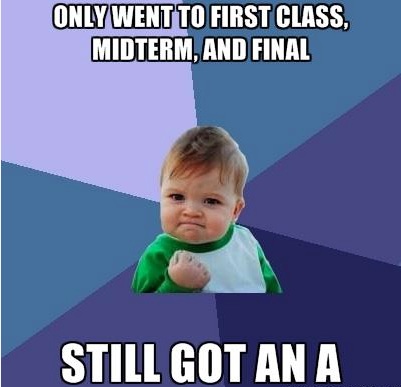
            The third generator was a meme generator, which is typically a picture from a movie, book, show, or some other entertainment showing for example someone making a very clear facial expression that is then used to describe different situations in which someone would make that exact face. Of course we know that even though there could be hundreds of conventions in a genre not all have to be used in each piece. In memes we found different conventions used for different memes. One convention would be the use of two phrases. For example there is a picture of a baby holding his fist up almost in celebration and the top phrase reads “only went to first class, midterm, and final” and the bottom phrase read “still got an A”. Most memes are set up this way in which there is a phrase and then the image and then the last phrase. It is set up this way because the order in which someone usually looks at a picture is up to down. Another convention that was used was the use of images. The images themselves almost all came from a very popular source like Charlie and the Chocolate Factory, Game of Thrones, NBA games, Rap Concerts, or a normal person making a name for them by taking a super funny picture.

            In essence, each genre generator consisted of conventions that consistently came up. The reason why they consistently came up because these generators realized that to make something fit successfully in a genre SOME conventions need to be included. However, we also did see how there were some comics and memes that took it upon themselves to be unique and did not use as much conventions often making up their on scheme for a meme or comic.